The additive manufacturing industry is growing up — and the conversations at AMS 2026 reflected exactly that.
Held in New York this February, Additive Manufacturing Strategies brought together hardware makers, material suppliers, software developers, and end users to take stock of where the industry is headed.
The message that resonated across sessions was clear: The era of chasing machine capabilities is giving way to a sharper focus on applications that deliver real, measurable production value.
Scaling is the new frontier
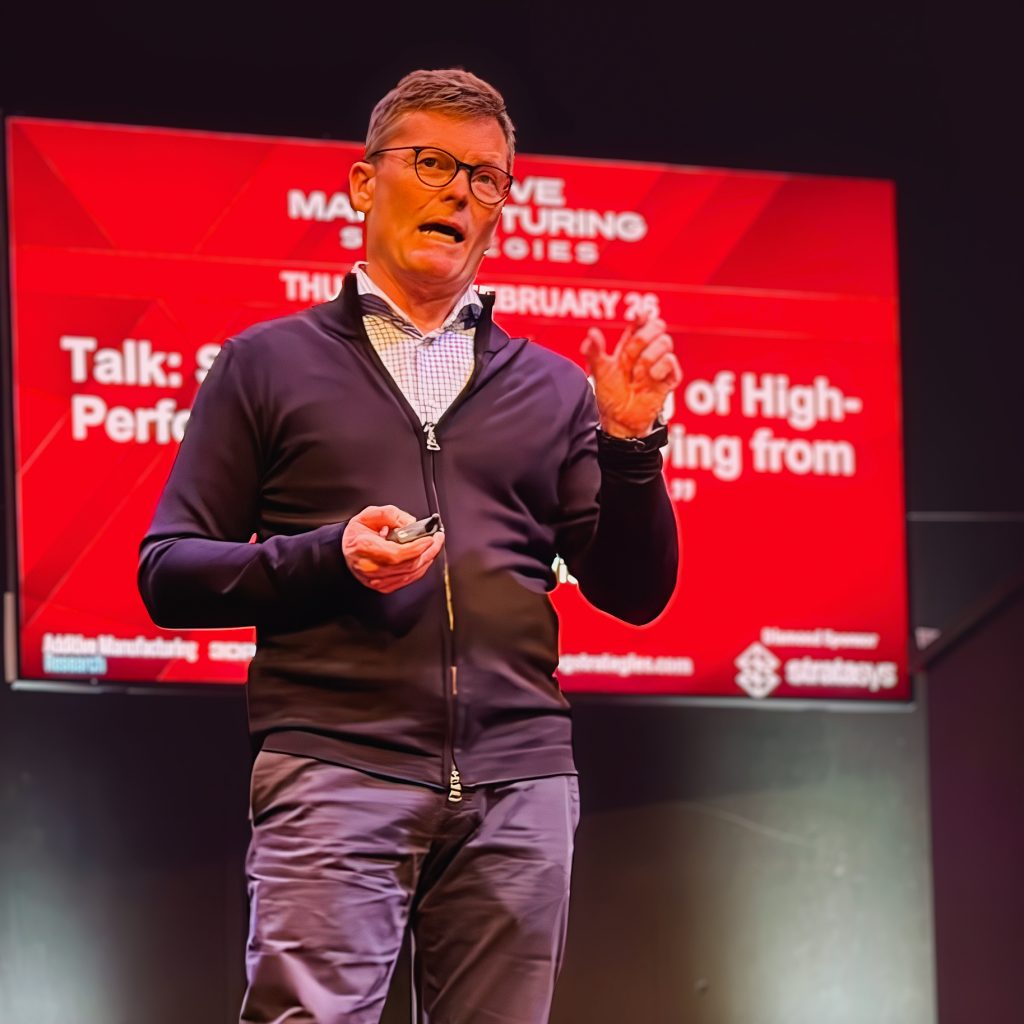
Visitech CEO Øyvind Tafjord addressed this shift head-on in his presentation, “Scaling DLP printing of high-performance parts – moving from bottles to tankers.” The title alone captures the challenge the industry faces: it’s not enough to print a great part. The real question is whether you can do it at volume, at cost, and with the repeatability that industrial production demands.
Cost per part is where the economics of additive manufacturing either make sense — or don’t. And for DLP-based systems, build area has traditionally been the bottleneck. A fixed projection footprint means limited throughput, which means cost per part stays stubbornly high regardless of how good the machine is.
Visitech’s scrolling DLP technology attacks this problem directly. By moving one or more light engines dynamically across the build area, the technology removes the volume ceiling that has long constrained static DLP systems. More parts per build, more builds per hour — the compounding effect on cost per part is substantial. What once required multiple machines can be achieved with a single, scalable scrolling system.
From promising to production-ready
The broader theme at AMS 2026 is one Visitech knows well: The gap between a technology that works in the lab and one that performs reliably in a factory environment. Precision, repeatability, and uptime aren’t optional at industrial scale — they’re the baseline.
As additive manufacturing continues its shift from prototyping to production, the companies that will lead aren’t necessarily those with the most capable machines. They’re the ones who can translate that capability into consistent, scalable output — at a cost that makes industrial deployment a genuine business case.
Missed the session in New York? Watch the full presentation below.
Share