How the LRS 8KA Laser 405 brings lithography-proven laser technology to additive manufacturing, and where lasers could take us next.
Our work at Visitech is all about turning light into precise images. We see a potential future where more and more of that light comes from lasers. In this issue, we put the pieces together: where our laser experience comes from, how it shaped the new LRS 8KA Laser 405, and what it can mean for machine builders who need more output, as well as for applications that go beyond classic 3D printing.
Proven in lithography first
Lasers are not new to us. Our LUXBEAM® Lithography System (LLS) products have used laser light for years, first alongside LEDs and later as pure laser light sources. The reason was simple: customers asked for more power, and lasers delivered it. In lithography, more power means each pattern can be exposed in less time, and less time per exposure means more panels through the machine every hour.
We also brought lasers into additive manufacturing early, in systems for polymer powder bed fusion. There, the job is not to cure a liquid resin but to melt plastic powder, which takes far more energy. Each project taught us something about building laser light sources that are powerful, compact, and reliable enough for industrial production. That knowledge is the first piece of the puzzle. To compete with traditional spot laser systems, we can actually show a competitive edge paired with scrolling technology in series production throughput.
The problem with going big
Machine builders want larger build areas, because more parts per build area means more output from the same machine. But light behaves a bit like butter on toast: the bigger the slice, the thinner it spreads. When the same optical power covers a larger image, the power density drops. Double the area, and each square centimeter receives roughly half the light, so every layer needs a longer exposure and printing slows down.
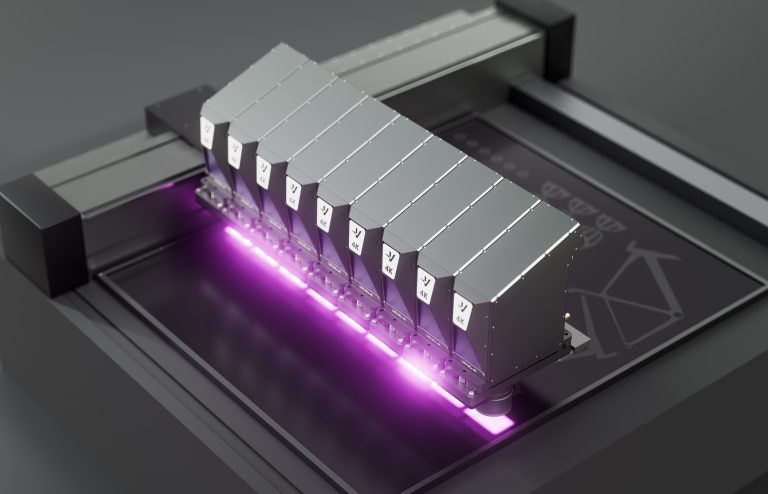
The usual answer is to stack several projectors side by side, each covering one part of the build area. In a 3D printing machine, that means aligning, stitching, calibrating, and matching every projector so the seams between the images never show up in the printed part. It also means more electronics, more cooling, and more cables in a tight space. And when one light source fails, the whole set needs rebalancing.
“Imagine a two-by-two projector installation. One LED dies, and suddenly the power balance across the field doesn’t match. You have to recalibrate all four projectors to each other again. With the LRS 8KA, you just plug a new light source into a single projector and continue again right away. No additional need for cumbersome recalibration.”
Alfred Jacobsen, Project Manager, R&D, Visitech
Meet the LRS 8KA Laser 405
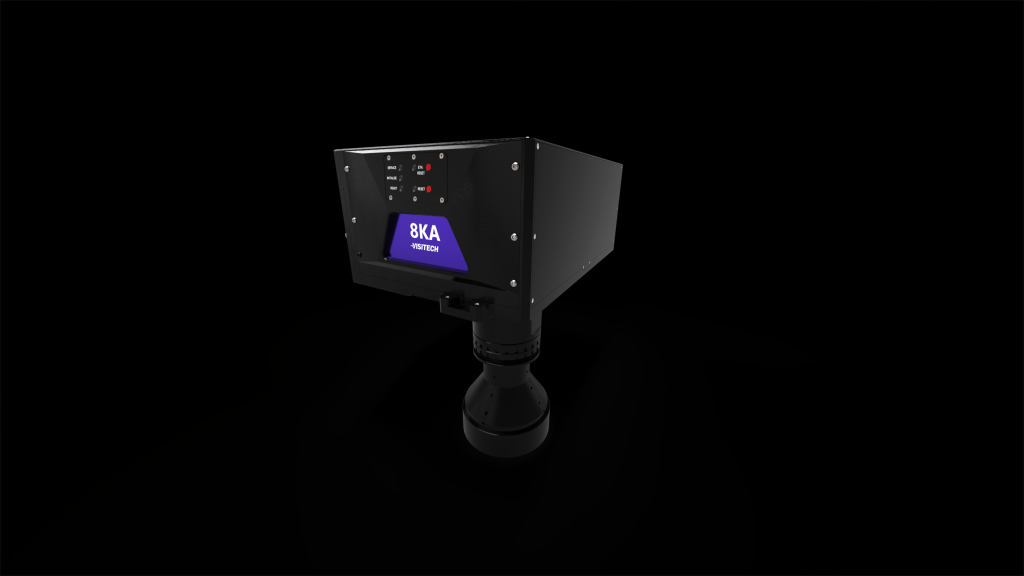
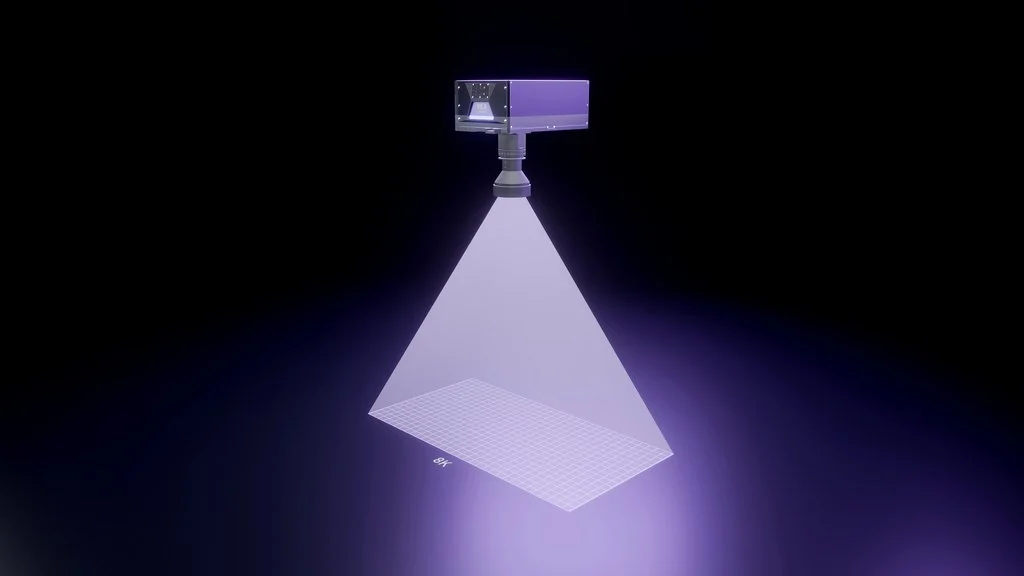
So we took our laser experience and combined it with the optical core of our 4K light engines. The result is the LRS 8KA Laser 405, a UV DLP light engine built for production-scale additive manufacturing. Instead of adding more projectors to cover more area, we put more light into one.
Why a laser? A laser module delivers a lot of optical power from a compact unit, and our light source runs with constant flux and optical feedback. In plain terms, the engine measures its own output and keeps it steady, layer after layer, through long production runs.
Three times the power. Twice the build area. Half the cost.
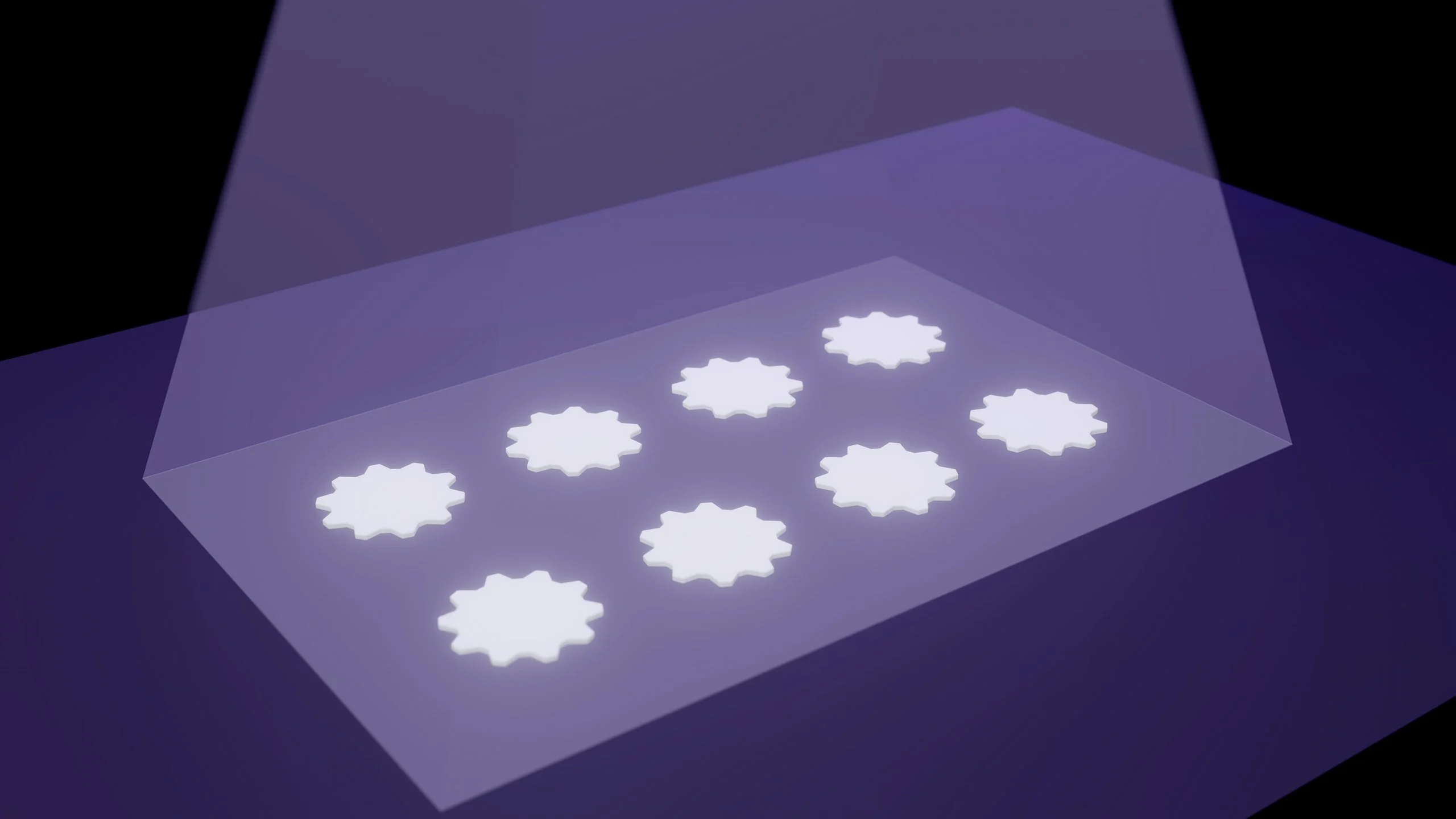
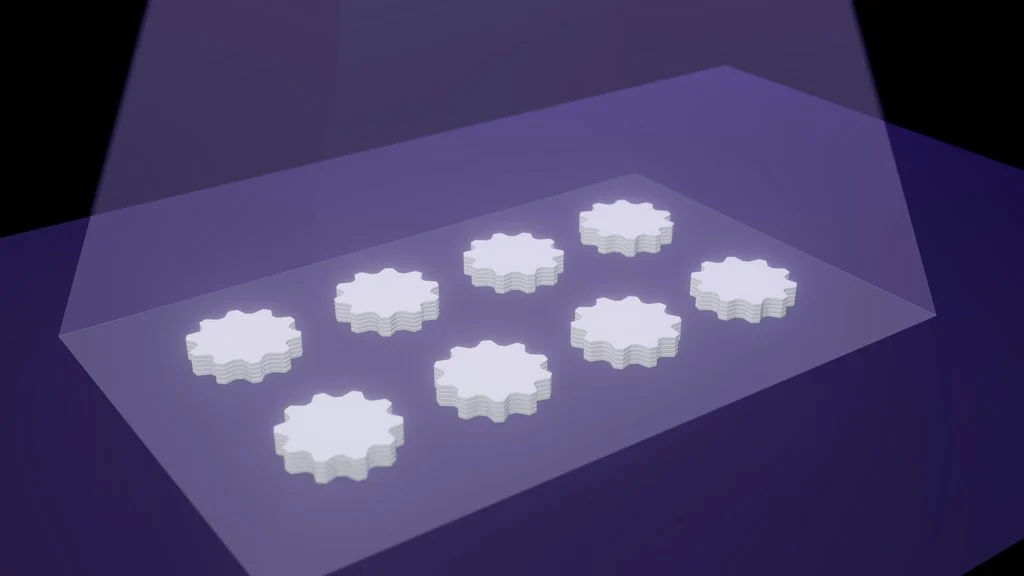
Three times the power. Over 30 W of UV light in the image from a single light engine. This is the piece that solves the butter problem: the extra power keeps power density high as the image grows, so exposure times stay short even across a large build area.
Twice the build area. Compared to our LRS 4KA, the LRS 8KA covers twice the area at the same resolution. Inside the engine, a precise optical actuator shifts the image by half a pixel between four positions during each exposure. Together, this gives more than 35 million addressable pixel positions, enough to keep fine details sharp across the whole platform.
About half the cost. One engine replaces a stack of projectors, and one Ethernet connection replaces four graphics cards, four HDMI and four USB connections. That means less hardware to buy, less cooling to design into the machine, and fewer hours spent on integration and alignment.
What changes on the production floor
With one image instead of several, there is no slicing, edge blending, or stitching to manage. Power uniformity stays above 99% (after software correction) across the full build area. For production, that consistency matters as much as speed, because it makes results predictable from one build to the next.
Service gets simpler too because the laser module is factory-calibrated and field-serviceable. When it needs replacing, technicians swap it without taking the optical system apart or recalibrating it, and the machine goes back to printing. On a production line, downtime is often the most expensive part of any repair or maintenance, so a quick and simple swap makes a real difference.
For integration, every LRS 8KA ships with our LAMA™ Standard software, built for additive manufacturing. Its virtual projectors let your engineers develop and test the machine software in parallel with the hardware, instead of waiting for the first unit to arrive. That shortens the road from first design to finished machine.
Where it already makes a difference
The first application we have seen is shoe printing. Footwear production needs large build areas to raise throughput, and until now that has often meant stacking several low-cost projectors, with all the alignment and service work that comes with them. A single LRS 8KA offers a simpler route to the same goal: one engine, one image and one light source to maintain.
To put this into numbers: in one customer implementation, a single LRS 8KA covers a build area of 820 x 435 mm at a 100 µm pixel pitch, delivering up to 8 mW/cm² across the whole area. That is a build area previously reserved for multi-projector setups, now handled by one light engine.
We also see potential in ceramic and metal printing. Here, the resin is filled with ceramic or metal particles, and these slurries absorb and scatter part of the light. They need higher power to cure each layer properly, so more power helps speed up these processes, even at medium build sizes.
Beyond 3D printing
Lasers also open doors outside classic 3D printing. One application we find especially exciting is hologram printing, security features, and patterns. These features must be precise, consistent, and very hard to copy, which is exactly where controlled laser light and accurate projection optics come into play.
Every new application has its own needs, whether that is a different light source, a different image size, or different projection optics. That is why we see our light engines as a toolbox rather than a fixed recipe, and why we are open to discussing projects where laser light could solve a problem, whether in 3D or 2.5D.
“We receive interest in our laser technology from big players in the industry. That is a clear sign that existing solutions and developments in the market are not satisfying customer needs, and we have an overlooked advantage in the market.”
Kristers Moisejs, Manager Product & Revenue EMEA, Visitech
Putting the pieces together
Lithography gave us the laser experience. Additive manufacturing gave us the challenge of bringing more power to larger build areas. The LRS 8KA Laser 405 is where those pieces meet, and new applications such as security printing show that the picture is far from finished.
Creating images – together.